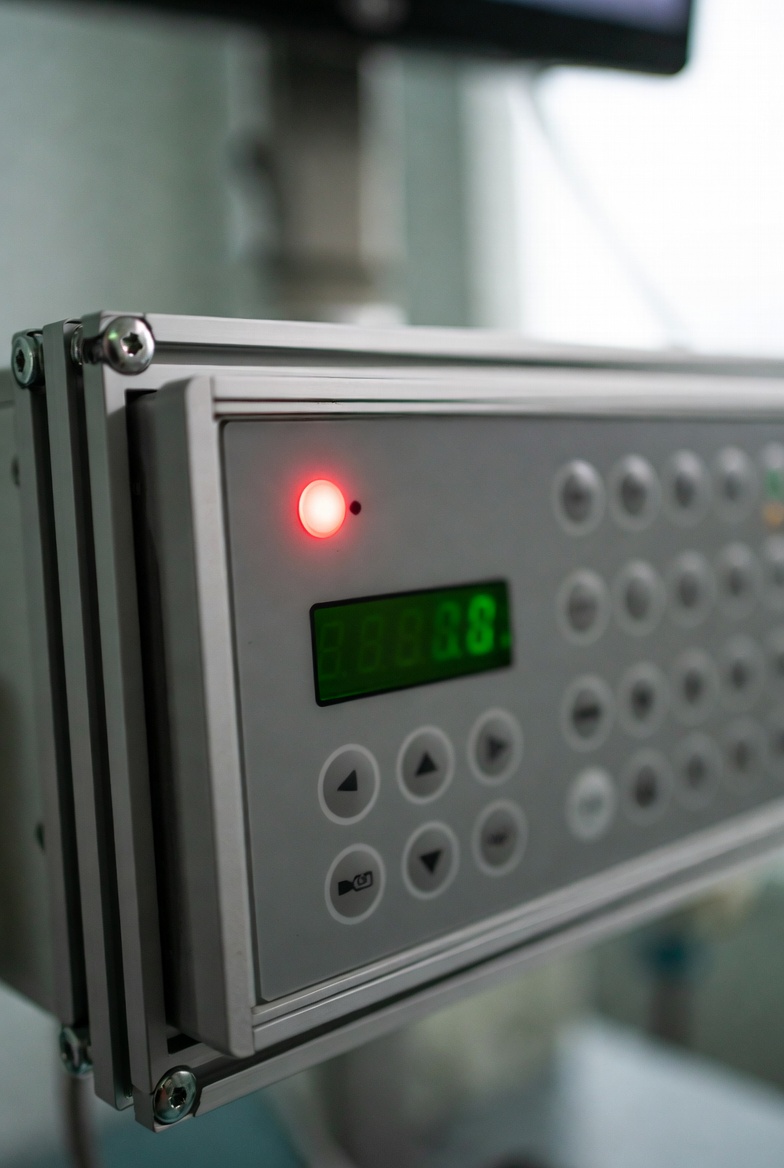

Although IEC 60601-1 Ed 3.2 has been published since 2020, some manufacturers are still working on upgrading. One construction requirement that frequently catches manufacturers off guard is Clause 7.8.1 – Indicator Lights and Controls. Here’s what changed, the implications for device design, and how MECA can help manufacturers navigate it efficiently.
What Changed from Ed 3.1 to Ed 3.2
Table 2 of Clause 7.8.1 was significantly revised in Ed 3.2. Arguably, where Ed 3.1 left room for interpretation, Ed 3.2 is explicit. The updated table defines:
- The name and meaning of each indicator light
- Whether the LED illumination is solid or flashing
- The associated color
- Whether it qualifies as an indicator light or an alarm indicator light
- Whether it is accompanied by a sound
- Any required operator response
Why This Matters
These distinctions have real implications for how the device is evaluated, especially for flashing yellow or red indicator lights that were never intended to be part of an alarm system.
If a device has indicator lights whose colors or behaviors don’t align with Table 2, this must be addressed before MECA can issue a fully compliant test report.
Examples
A common scenario is a red flashing indicator light on a device that has no alarm system, which is in direct conflict with Table 2. In this case, there are two pathways forward:
Option 1: Design Update – Update the color and/or behavior of the indicator light to bring it into compliance with Table 2. This is the most straightforward path when feasible.
Option 2: Alternate Testing Pathway (IEC 60601-1-8) – If changing the indicator light is not practical (for example, because it is well established among users and changing it would create usability concerns), there is an alternate route. Table 2’s footnote “a” allows indicator lights to be treated as information signals rather than visual alarm signals, provided they are evaluated to IEC 60601-1-8:2020.
Under this pathway, MECA evaluates all applicable requirements for information signals and tests the indicator light to confirm its flash frequency and duty cycle fall outside the ranges specified in Table 2 of IEC 60601-1-8:2020 for a high priority alarm. If the values are outside those ranges, the indicator light is considered perceptibly different from a high priority alarm signal, and compliance with Clause 7.8.1 of IEC 60601-1 is demonstrated.
As another example, for solid (non-flashing) indicator lights, MECA will verify during evaluation that the light is being used to indicate warning, caution, or ready-for-use status, consistent with its assigned meaning.
What This Means for Overall Project Timeline
Both pathways carry time implications that can affect a manufacturer’s overall project schedule. That’s why Clause 7.8.1 is one of the first construction requirements MECA reviews during an upgrade evaluation. Identifying issues early allows us to work through the options with the manufacturer before they become schedule-critical.
If you’re planning a device upgrade and want to understand how this requirement may apply to your product, contact us to discuss your project.